
Are you feeling festive yet?
Some of you may have started singing Christmas carols as soon as Halloween was over, others may be holding out as long as possible – or at least until December.
Here at Ghost Fishing UK, we’ve been thinking about the holidays since April – and coincidentally with April, a glass artist based on combination farm/studio/cafe in Somerset.
She’s been working hard for months to create custom GFUK sun catchers to offer our supporters a unique gift this festive season.

April Pebble has always been drawn to art: “I think when I was younger, being a dyslexic person, I found it hard to take in lots of new information.
“But when I interacted with a piece of artwork or an art installation, I felt inspired and engaged.
“I remember visiting galleries or festivals and just being overwhelmed with subjects that were coming out to me.
“Something as simple as a big lamp that was a flower would make me think about the flower’s beauty and fragility, and the need to care for our planet and our species.
“Some people’s way of communicating is writing, others it’s talking, but for me my way of communicating is through making.”
“It feels great when my art can be a voice and a vehicle for a bigger message.”
April studied glass blowing, then horticulture, then learnt how to create fused and stained-glass art.
She spent three years doing conservation work for Holywell Glass in Wells, cleaning and conserving stained glass for historic National Trust properties, churches, and cathedrals across the UK.
For the last seven years she’s been working as an independent artist and is now based out of a studio space on a farm in Somerset, bringing in her love of nature and ecology to create art that helps show the importance of conservation.
“Pretty much all of my work is inspired by nature.”, April said.
“I did a series of panels on an underwater ecosystem with sea urchins and kelp as part of an ecology course; I just finished a panel of red kites, because there are a lot of red kites in Somerset.
“I come from quite a traditional background of study, but now it’s about pushing the boundaries and seeing what I can do with the skills I have acquired.
“In our throw away culture I also try to raise awareness of the longevity of stained-glass – a panel could last for hundreds of years with the right care.”
When asked about how stained glass is faring compared to other heritage crafts that may be in decline, April said: “Stained glass has definitely had a bit of a revival, since ‘The Repair Shop’ TV show; I think that’s made stained glass have a bit of a comeback into the public eye.
“I run workshops and there’s always people wanting to learn the technique because they’ve watched it.
“Stained glass is quite a niche subject, but I think there’s definitely a love for it in this country.
“I think most people look up at a stained-glass window in a cathedral and love the colours and want to know how it’s made.”
But there are also challenges: “In the UK a lot of the glass degrees have shut, there’s been a real decline in people signing up.
“There are studios in the UK that offer apprenticeships, but you have to happen to know about them and get involved, and they are not so common anymore.
“People are trying to revive it, when I run workshops that’s what I’m trying to do.
“I’m trying to tell people as much as I can so that they can learn, and pass it on, or do more study.
“I like the idea of people keeping a craft alive, in that sense.”
In terms of connecting with Ghost Fishing UK for the suncatchers, there was a little bit of kismet involved: “One of the divers involved in Ghost Fishing UK, Rich Walker, happens to be someone that regularly comes to the farm, has come to the cafe and liked some of my glasswork.
“And he approached me and asked if I’d be interested in making something based on the work that Ghost Fishing UK does.
“I was very intrigued because I’m very interested in conservation and what’s happening to our wildlife across the seas and in the countryside in the UK.
“A lot of my projects have that in mind – how can I make artwork that has a more political or conscientious topic or narrative behind it to highlight the ways that we can support and progress environmental work, especially during these times of climate crisis.
“So when Rich got in touch I was just so eager to get involved in some way, especially having done some diving myself.
“I can see your, and everybody’s, love for the underwater world and how it’s such a mystery almost, because it’s so inaccessible for most people.
“Sort of out of sight, out of mind.
“For the people who actually volunteer with Ghost Fishing UK and see firsthand all the debris that’s been left must be quite a shock.
“I just thought it was very interesting, the idea of cleaning up a space that many people don’t ever get to see.”
As mentioned before, the suncatchers are a special project that has been in the planning for months, with April creating the artworks from scratch, start to finish.
Even for an experienced artist, it was not a simple process: “I started designing by looking through some of the videos from Ghost Fishing UK, thinking what could it be?
“Could it be a net, or the logo with the seal emblem with the nets?
“And originally I designed a little stained-glass window, which I might still make, of a seal and the Ghost Fishing net pulling up all of the debris from the seafloor.
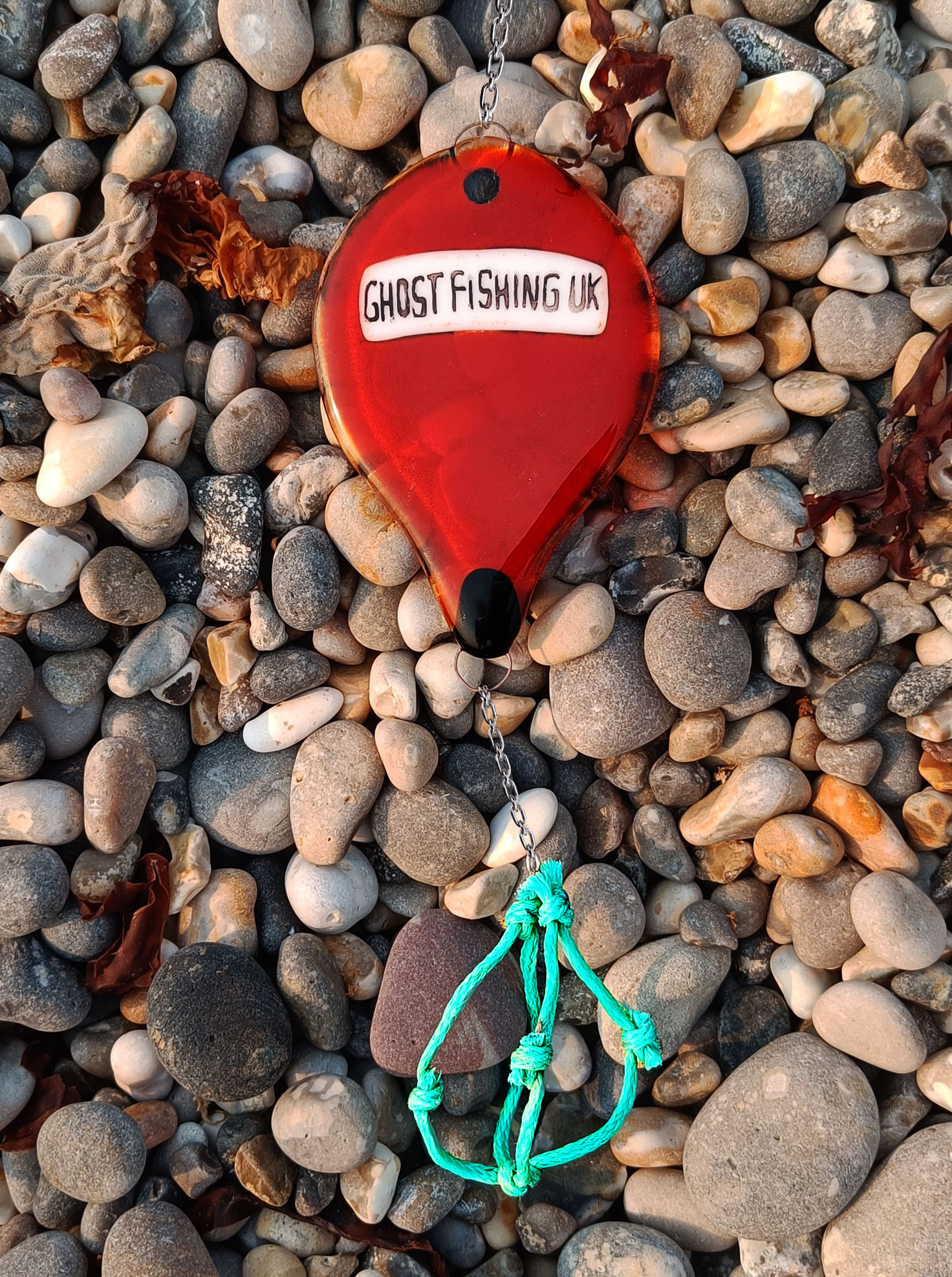
“But then I also created the little floats, the airbags using for lifting ghost gear to the surface, which we went with initially to see what they would look like.
“A lot of my other work is recycled using window glass and offcuts from glass projects; I make mosaics from these recycled bits.
“But when it comes to working with fusing glass, melting it into shapes, it all has to be compatible.
“When glass goes up to a really high temperature and then it cools down, it can cause it to separate if it’s not the same type of glass.
“It fires up to 800 degrees for fusing, which is quite a lot of heat.
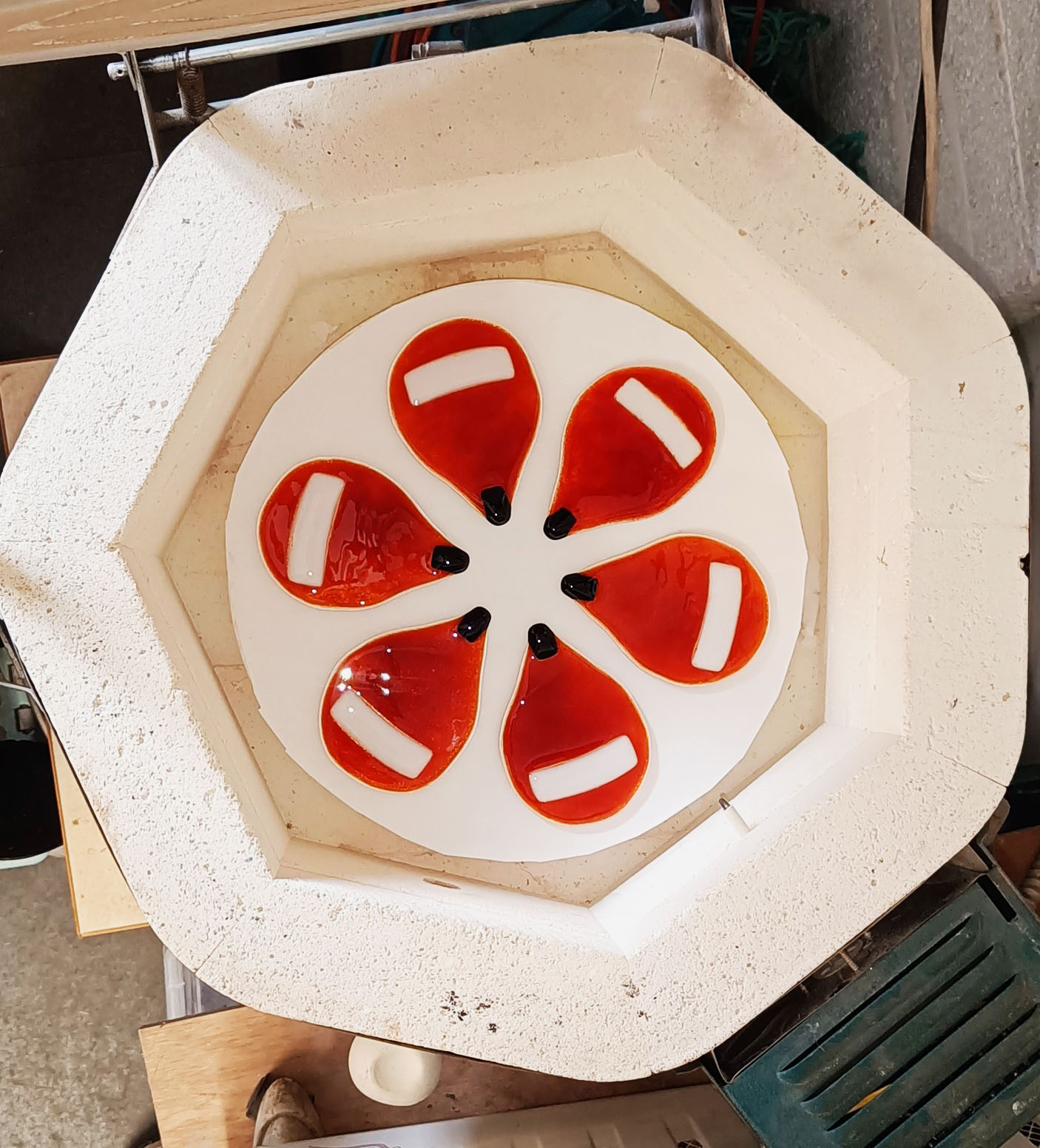
“Since I decided to make them out of fused glass, I just stick to one type, called Oceanside 96 ironically.
“I do have to get it from the U.S., which is tricky when you wish the glass was made in the UK.
“But glass production has had a massive decline in the last 50 or so years, we used to produce a lot more of it.”
Supply issues were one thing, but creating something that felt faithful to the real equipment used by GFUK was another: “The colour of the float is a rust colour, this lovely rusty orange, because obviously the airbags are such a bright colour.
“Trying to get that specific tone was quite interesting, I think I tried a few different colours to get the right one.
“It’s similar to a swim float as well, and I often do sea swimming so it just made me feel really happy to be able to create something like that which brings me so much enjoyment, also knowing it would feel very fulfilling pulling the nets off the sea floor.
“I used clear glass and added white glass to paint the logo on, then I used a sieve to add the orange colour as a powder, which gave the outline of clear glass on the airbag.
“I wanted to make it look like more of a bubble than a solid colour.
“It’s also why there are little batches of slightly different coloured oranges.
“But that was something I accidentally did because I didn’t have a whole piece of the coloured orange, so I decided to experiment and see what it looked like.
“And it looks so much better than actually using the orange glass.
“So it was a bit of a challenge at first, and then it actually turned out that I liked it more.
“You always learn things, don’t you, when you don’t do it the way it’s supposed to be done – when you experiment.
“I painted the name of Ghost Fishing UK onto the front, but there was a little trial and error.
“The first painting was using a stencil that made it a bit too spooky, and I didn’t want it to seem like a sinister underwater thing.
“So I adapted it to match the Ghost Fishing UK font exactly.”
To really get a sense of the care and effort that went into the process, you must understand how long it takes to create a single suncatcher.
“It took two firings, one was the fused glass for the shape, and then the firing for the stained-glass paint and to add the little hooks for hanging.
“Each one takes about two hours of actual work, but between firing and cooling around 30 hours total.”
There is an extra special personal touch for the rest of the suncatcher as well: “The nets are actually from the sea floor, straight from a Ghost Fishing UK project.
“I created little bundles then stitched them up into a net shape.
“And I used a chain that is supposed to be similar to the chains that are on fishing boats so that they look like they’re coming from the sea.”
And they truly do look like they’ve come straight from a GFUK project; a meaningful symbol of the great work made possible by our supporters and volunteers all year round.
The suncatchers are exclusively available on the GFUK website: https://www.store.ghostfishing.co.uk/product-page/sun-catcher
To see more of April’s work, or join one of her workshops, visit: www.aprilpebble.co.uk.
Text by Anja Jungmayr